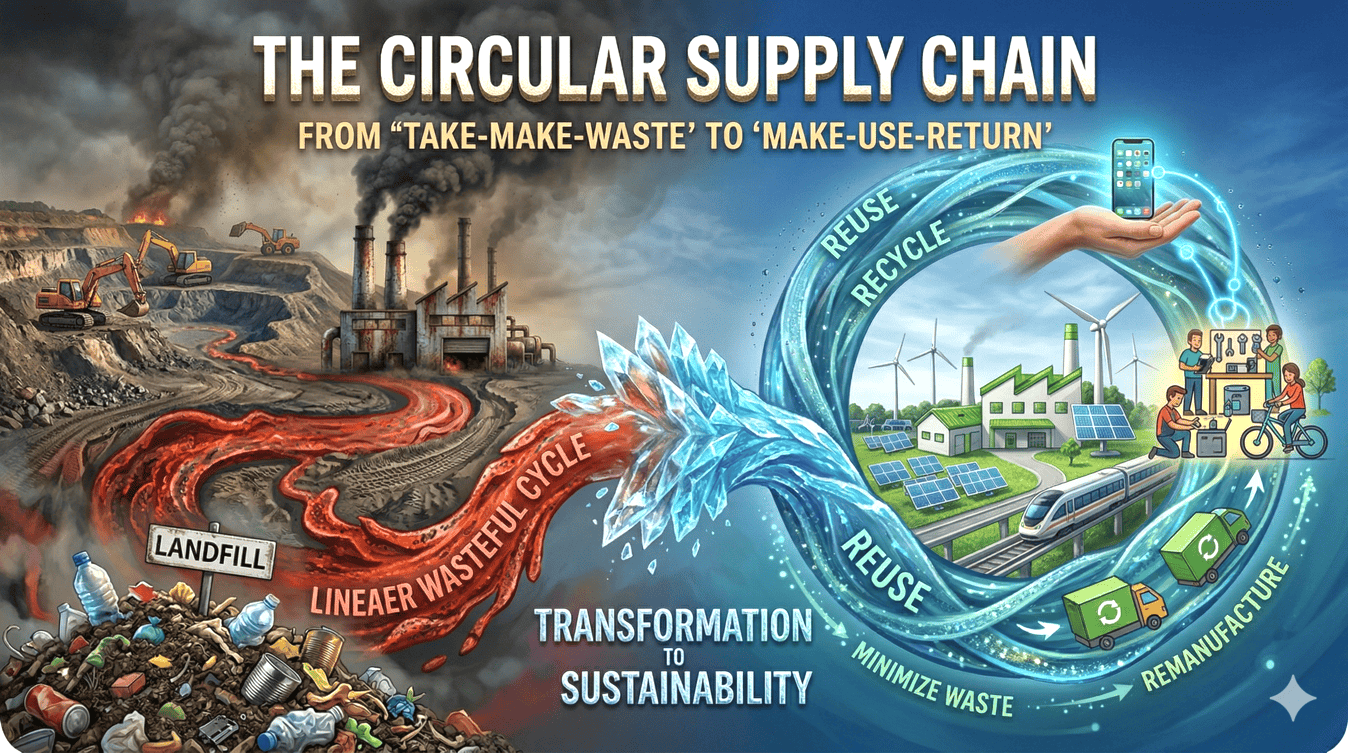
For the last century, supply chains have operated on a linear model: take raw materials, make a product, use it, and throw it away (waste). This model is not only environmentally unsustainable; it is becoming economically and legally untenable. The future belongs to the Circular Supply Chain.
The driving force behind this shift is regulation. The European Union’s Circular Economy Action Plan is a landmark piece of legislation that mandates products sold in the EU must be designed to last longer, be easier to repair, and be fully recyclable at end of life. Similar "Right to Repair" laws are spreading across the U.S. This forces companies to take responsibility for their products long after they are sold.
For Supply Chain professionals, this requires a complete overhaul of logistics. You can no longer just think about forward logistics (getting the product to the customer). You must build robust Reverse Logistics networks to handle returns, refurbishment, and material recovery. How do you efficiently take back a used smartphone? How do you disassemble it and feed the rare earth minerals back into your manufacturing process?
Industry leaders like IKEA, which has pledged to become a fully circular business by 2030, are already investing in furniture take-back schemes and rental models. Patagonia repairs and resells its clothing. By 2026, this will be the norm. The most successful supply chain managers will be those who view waste not as a cost of disposal, but as a resource input for the next production cycle. The linear chain is becoming a circle, and the job of SCM is to keep it spinning.
surfyn.fr
May 02, 2026Sujet intéressant, mais vous passez sous silence un élément clé : très peu consultent réellement l'autorité de régulation avant de s'inscrire. C'est malheureusement la réalité.