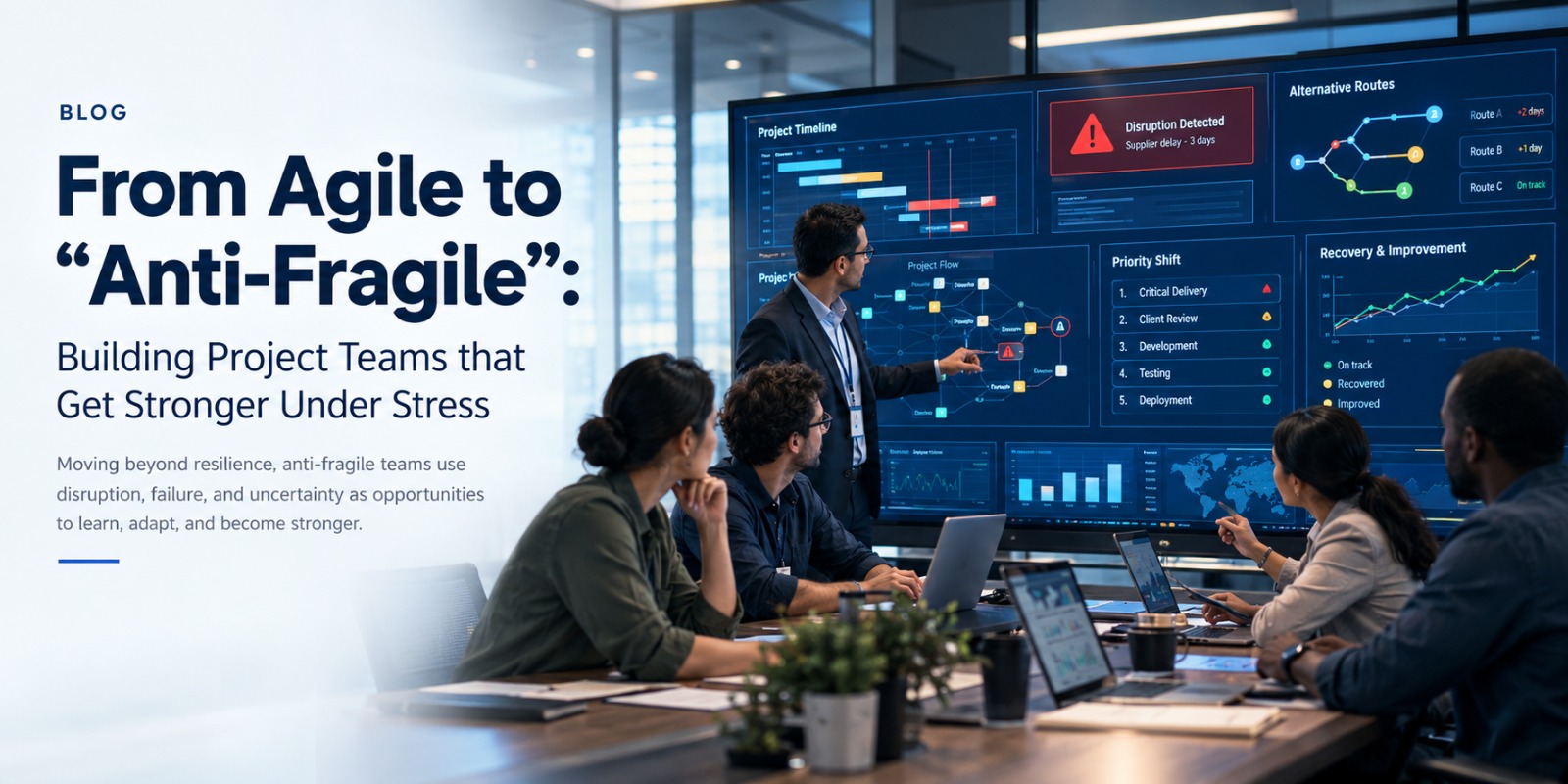
Agile methodology taught us to be resilient to adapt to change and bounce back from setbacks. But in a world of constant volatility, simply bouncing back to where you started is not enough. You need to bounce forward. This is the concept of Anti-Fragility, a term coined by author and scholar Nassim Nicholas Taleb.
An anti-fragile system is one that gains from disorder. Think of the human immune system: it doesn't just resist a virus; it gets stronger because of the exposure, building antibodies for the future. In project management, an anti-fragile team is one that uses every failure, every missed deadline, and every conflict as a catalyst for improvement.
In 2025, project management training is shifting to focus on how to build this capability. It starts with psychological safety. If team members are afraid to admit a mistake or report a near-miss, the team loses the opportunity to learn. Anti-fragile teams celebrate "intelligent failures" failures that occur while trying something new and that yield valuable insights.
It also involves building redundancy and optionality into the project plan. Instead of a single critical path, anti-fragile projects have multiple paths. Instead of one expert who knows a key system, there are two. This "distributed" structure means that when a stressor hits someone quits, a vendor fails the system doesn't just survive; it reorganizes and becomes more robust. By 2026, the most sought-after PMs will be those who can turn volatility into a training ground for strength.
Reader Comments (0)
Leave a Comment
Your email address will not be published. Required fields are marked *